All the Director’s games

How the Director made Nightcoast

“A night-coast survival game where broken machines hunt you.”

What the person asked for, 30 September to 1 October 2026

The first of the Director's runs. A separate Claude Code session, running Opus 5.5, was the Game Director for an empty game. It had Gamewright's tools and nothing else: no shell, no way to read files, no way to write code. Everything it learned came through the tools, and everything it changed was a proposal. The person decided on each one, answered briefly, and looked at the game before saying it was played.

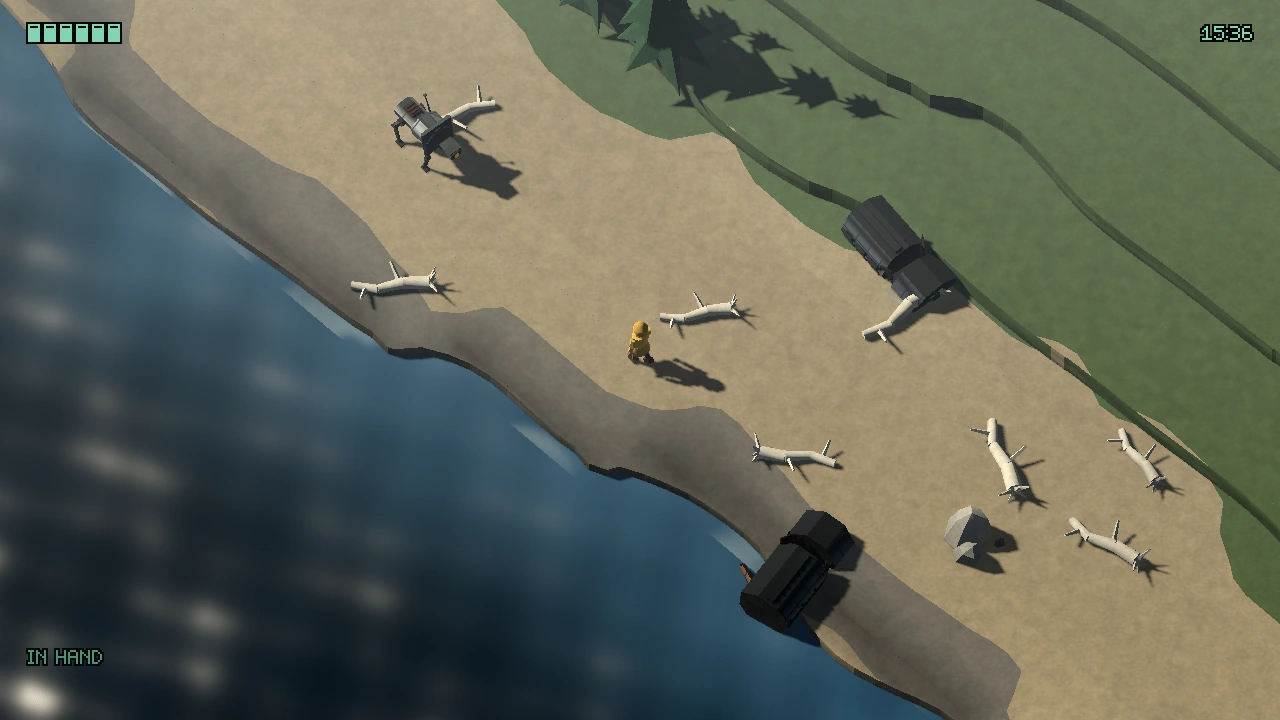
Nightcoast, a frame the engine drew in the browser
Nightcoast, as it plays on this site.
Turns
9
Model time
$12.18
Changes applied
18its proposals, and the person's mark that it was played
Turned down
9most of them drafts the Director couldn't withdraw itself
Commits
21in the game's own history, with an undo and a redo
Asked the engine for
2a second attack, and machines that read at night

The conversation, turn by turn

The person’s words are quoted as they were said. The rest is what the Director did, in plain words, from the run’s own record.

What the words mean: proposal, checks, playtest, played
Proposal
Every change the Director makes is a proposal: the documents it would change, checked before anyone is asked. The person approves it or turns it down, and can undo it later. Proposals can be stacked, each on one not yet approved; they are approved in order.
Checks
Before a person sees a proposal, every document is checked, the game boots twice and must end the same both times, and its playtests run. The frames it draws are checked when asked.
Playtest
A test the game carries with it: bots play the game and a result is checked, such as whether a bot that dodges wins its fights.
Played
The person's mark that they have played the game. Until then a game keeps placeholder looks.
Asking the engine
When a game needs something the engine can't express, the Director asks for it instead of faking it. The engine may grow a kit: a reviewed feature every game can use.
Model time
What each of the Director's turns cost in model use, as recorded at the time.
  1. Turn 1

    Cost
    $0.26
    Time
    12 s
    The person

    “A night-coast survival game where broken machines hunt you.”

    The Director

    Read its guide and picked the action-survival template. Before guessing, it asked the template's three required questions, each with a suggested answer, and suggested keeping the game small.

    Proposed

    Nothing yet: it asked first.

  2. Turn 2

    Cost
    $0.30
    Time
    39 s
    The person

    “Go with those, but one kind of machine, a sentry. The lamp from driftwood and a salvaged cell. About ten minutes.”

    The Director

    Wrote the brief: a pitch, the loop of play, limits on scope, and three pillars. Tactics beat stats. Light is a bargain. Salvage feeds survival.

    Then it proposed the brief again, to use the engine's own verbs, such as harvest and crouch.

    Proposed

    The brief, twice. The person approved one. The other was left for them to turn down: the Director had no way to withdraw its own draft.

  3. Turn 3

    Cost
    $0.21
    Time
    42 s
    The person

    Approved the brief, and said:

    “make the game, then slices, stacked, with a Playtest”

    The Director

    Proposed the game itself. It explained that it couldn't yet stack the first slices of play on a game that wasn't approved, so that would have to wait a turn.

    Proposed

    The game. The person approved it at the start of the next turn.

    The checks

    Green.

  4. Turn 4

    Cost
    $2.62
    Time
    10 min 10 s
    The person

    Approved the game.

    The Director

    Built the game in three slices: salvage and the lamp; the sentry, with a plate in front and a vent on its back, dormant by day; and one night, from 15:00 to dawn. It made three repairs, and wrote playtests for salvage, tactics, trading blows, and a full run.

    Unasked, it raised a design problem: kill the sentry early and the rest of the night is empty.

    Proposed

    Three slices, each stacked on the one before, and three repairs.

    The checks

    46 playtest runs green. After this turn the person ran the frame checks too, and took shots of the start and the night in the real player.

  5. Turn 5

    Cost
    $2.12
    Time
    18 min 26 s
    The person

    “Played it: the night is dark and the fight reads; the message is cut off; every prop looks like the same rock. Mark it played, then the look.”

    The Director

    Marked the game as played, because the person asked. Until then a game keeps placeholder looks, by design: the sentry had looked like a second survivor.

    Then the look: its own models for the driftwood, the wrecks and the sentry, a message line that wraps instead of being cut off, and a yellow oilskin for the survivor. It said exactly which looks it had seen and which it hadn't.

    The sentry at night stayed red on the readability check: too dark to read. It said so rather than claim it fixed, and asked the engine for an outline that would make machines read at night.

    Proposed

    The look: models, the message line and the oilskin.

    The checks

    The frames of the sentry at night without the lamp still failed the readability check.

  6. Turn 6

    Cost
    $0.86
    Time
    5 min 40 s
    The person

    “The sentry is too easy. Make the sentry faster and give it a second attack.”

    The Director

    Made it faster: chase speed 4.4 → 5.0 m/s, recovery 500 → 400 ms, the wait between attacks 800 → 600 ms. It left the sentry's tell, the warning before it strikes, unchanged, so the attack still reads.

    It tried a faster patrol too, saw two fights never start, and dropped it.

    A second attack was something the engine couldn't express yet, so it asked the engine for one instead of faking it. And it named what the bots couldn't measure: damage taken, and escaping a chase.

    Proposed

    One change, with a report comparing every playtest before and after.

    The checks

    A bot that dodges still won 20 of 20 fights; one that trades blows still won none of 20.

  7. Turns 7 and 8

    Cost
    $5.53 for both turns
    Time
    18 min 31 s for both turns
    The person

    “A Playtest that proves stealth matters.”

    The Director

    Wrote a stealth test: walk up to the sentry at 23:00, stopping at 9, 6.5, 4 and 2.5 m. The work was cut off by a session limit, then resumed, so it spans two turns.

    On one of the test worlds, a crouching player couldn't keep up with the sentry's patrol. After two repairs it stopped, and offered three choices with a recommendation instead of guessing a third time.

    Proposed

    The stealth playtest and two repairs, then three choices for the person.

  8. Turn 9

    Cost
    $0.26
    Time
    1 min 29 s
    The person

    “Option 1: test only the game's own world.”

    The Director

    Stacked the fix on its stealth test.

    Proposed

    The fix, stacked on the playtest.

    The checks

    49 playtest runs green. The report still flagged the 13 runs dropped on the other worlds: the check that guards against lost coverage, doing its job.

The result: Nightcoast

Nightcoast: a beach with driftwood and wrecks, a lamp made from driftwood and a cell salvaged from a dead machine, and a sentry that sleeps by day and hunts by light at night. You win by surviving to dawn, and lose if it takes your last health.

A first game from one sentence, through tools alone, in under an hour of model time.

What it proved

  • Its own full run: salvage, the lamp, the fight and a win at dawn, in 9 min 43 s of play.
  • Tactics beat stats: a bot that dodges wins 20 of 20 fights; one that stands and swings is downed in all 20.
  • Stealth matters: walking up lamp-lit, you are noticed every time; crouched in the dark, never, down to 2.5 m.
  • Every document is valid, two boots end in exactly the same state, and 49 playtest runs are green. Four of its six frames passed the readability check; the two of the sentry at night without the lamp didn't, at first (below).
  • Undo put the sentry's file back exactly as it was, byte for byte, and redo put the change back.
  • In a real browser, its stealth test ends in exactly the state the desktop player reaches.
  • Throughout, the Director asked before guessing, explained every check instead of working round it, repaired failures before asking for a decision, and never described a picture it hadn't looked at.

It takes a while to start: about 10 seconds in our browser check.

Controls

Arrow keys or WASD
Walk
Shift
Run while held; louder and faster
C or Ctrl
Crouch while held: slower, quieter and harder to see
E
Use what is in front of you: take, open, talk
J or Left click
Swing the held tool or weapon
Space or Right click
Dodge out of a blow; brief invulnerability
F or L
Light or douse the lamp
Tab or I
Open what you carry
M
Open what you can make
Esc or P
Pause the game
Enter or E
Confirm in menus
Esc or Backspace
Go back in menus

In menus

Arrow keys or WASD
Move
] or Page Down
The slate's next app
[ or Page Up
The slate's previous app

Plays on a phone or tablet too, with on-screen controls.

Nightcoast’s own page, with the other games

What the run found, and what happened to each

Each finding as the run’s write-up recorded it, and what has happened since.

  1. It couldn't change its own pending proposal.

    Fixed

    So a duplicate brief, fixes stacked on the slices they repaired, and drafts it made to diagnose problems were all left for the person to turn down.

    A proposal can now replace the Director's own earlier draft.

  2. A report on a brief alone came back red.

    Fixed

    It said “no game yet”.

    It now says “not a game yet”.

  3. Slices couldn't stack on a game not yet approved.

    Fixed

    That cost a round of conversation.

    A stacked proposal is now checked at the stage its stack reaches, and checked again on approval against what is applied. That second check also closed a hole: a look could have been approved after the played mark was undone.

  4. Placeholder looks until the game was played.

    By design

    Until then, the sentry looked like a second survivor.

    A game keeps simple looks until a person has played it. The Director said so.

  5. A long message was cut off on screen, and nothing noticed.

    Fixed

    In progress when the run was written up. Since then, the frame check fails a line cut short, a wrapped label's lost lines, text off the frame, and text too small to read.

  6. Previews showed only approved changes.

    Fixed

    So the Director could see its pending look only in the before-and-after frames of failing checks.

    A preview can now show a pending change, beside the game as it was before.

  7. The readability check and the game's idea disagreed.

    Decided

    At night without light, every colour sinks toward black, so the sentry's body can't stand out: paler plating took its colour difference from the ground from 4.8 down to 3.1, where the check wants 10. The game says darkness hides you; the platform says a threat must read at any hour. The sentry's lit lens is its warning, but the check measured only its body.

    A lit warning counts. The check now measures the pixels that go dark with a thing's glow, and both night frames pass by the sentry's lens, with the game unchanged. An outline at night stays the answer for threats with nothing lit.

  8. Two drafts to turn down for one change.

    Fixed

    Covered by the first fix: a new draft replaces the old one.

  9. Nothing measured damage taken, or escaping a chase.

    Fixed

    So “harder” couldn't be shown by bots that play perfectly.

    Every report now counts fights and chases, before and after on a proposal: damage taken, blows, time to kill, chases and escapes, the closest call and time kept away. A playtest can test each one.

  10. A proposal was the only way to try something.

    Fixed

    A draft can now be checked exactly as a proposal would be, with nothing recorded.

  11. The Director misstated the order of approval.

    Open

    It said approving the third proposal would apply all three. The game's store refused the out-of-order approval and named the right order, which is correct.

    Still to do: say it plainly in the Director's playbook.

The other runs

All of the Director’s games