“A small platformer: a fox hops across autumn rooftops collecting acorns before winter. Two or three short levels.”
What the person asked for, 1 October 2026
A separate Claude Code session was the Game Director for an empty game, on the platformer template. It had Gamewright's tools and nothing else: no shell, no way to read files, no way to write code. Everything it learned came through the tools, and everything it changed was a proposal. The person decided on each one, answered briefly, and looked at the game before saying it was played.
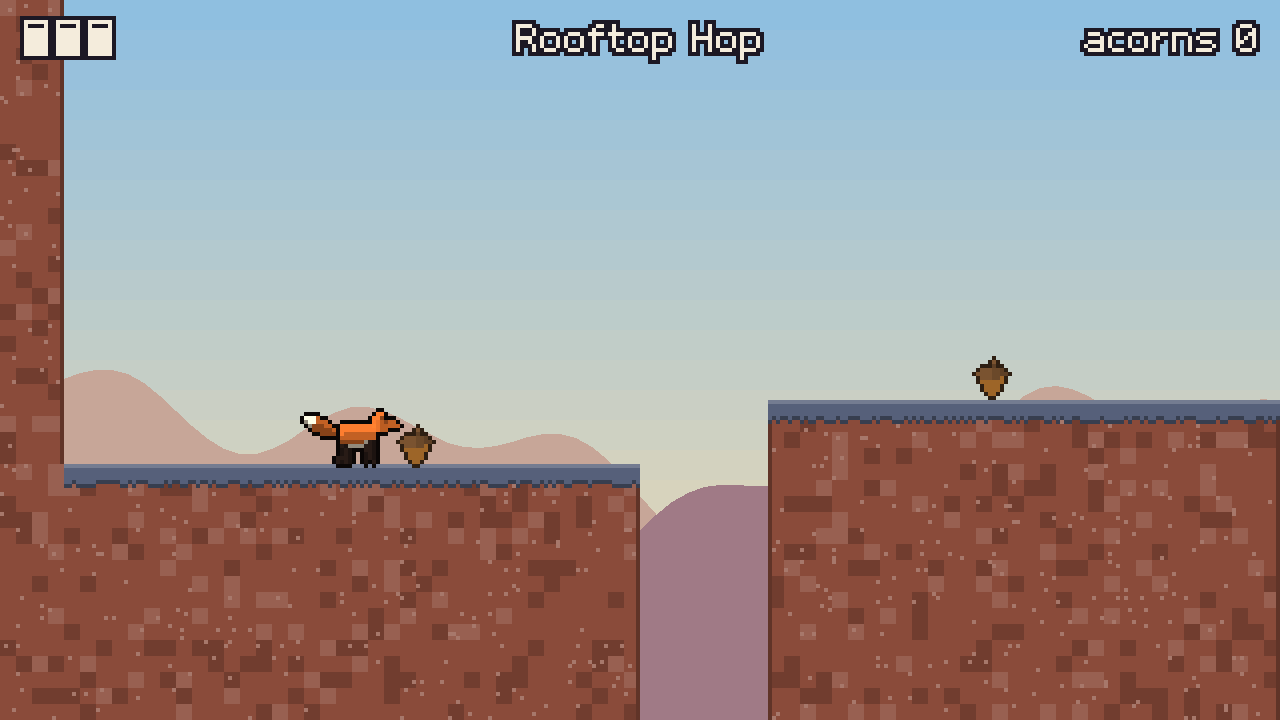
Acorn Rooftops, as it plays on this site.
Turns
4
Model time
$8.01plus a turn cut off at its limit, which reported no cost
Changes applied
13and 5 drafts replaced by later ones
Commits
14in the game's own history
New kits needed
None
Asked the engine for
2sprites that leave play alone, and animals that can be animated
The conversation, turn by turn
The person’s words are quoted as they were said. The rest is what the Director did, in plain words, from the run’s own record.
What the words mean: proposal, checks, playtest, played
Proposal
Every change the Director makes is a proposal: the documents it would change, checked before anyone is asked. The person approves it or turns it down, and can undo it later. Proposals can be stacked, each on one not yet approved; they are approved in order.
Checks
Before a person sees a proposal, every document is checked, the game boots twice and must end the same both times, and its playtests run. The frames it draws are checked when asked.
Playtest
A test the game carries with it: bots play the game and a result is checked, such as whether a bot that dodges wins its fights.
Played
The person's mark that they have played the game. Until then a game keeps placeholder looks.
Asking the engine
When a game needs something the engine can't express, the Director asks for it instead of faking it. The engine may grow a kit: a reviewed feature every game can use.
Model time
What each of the Director's turns cost in model use, as recorded at the time.
Turn 1
Cost
$0.16
Time
not recorded
The person
“A small platformer: a fox hops across autumn rooftops collecting acorns before winter. Two or three short levels.”
The Director
Picked the platformer template and asked its three questions, each with a suggested answer: how it should feel, what the obstacles are, and whether the levels are made by hand or generated.
Proposed
Nothing yet: it asked first.
Turn 2
Cost
$1.98
Time
not recorded
The person
“Go with those; acorns just count; about a minute a level; build the first playable stacked, with a playtest that proves every level can be finished”
The Director
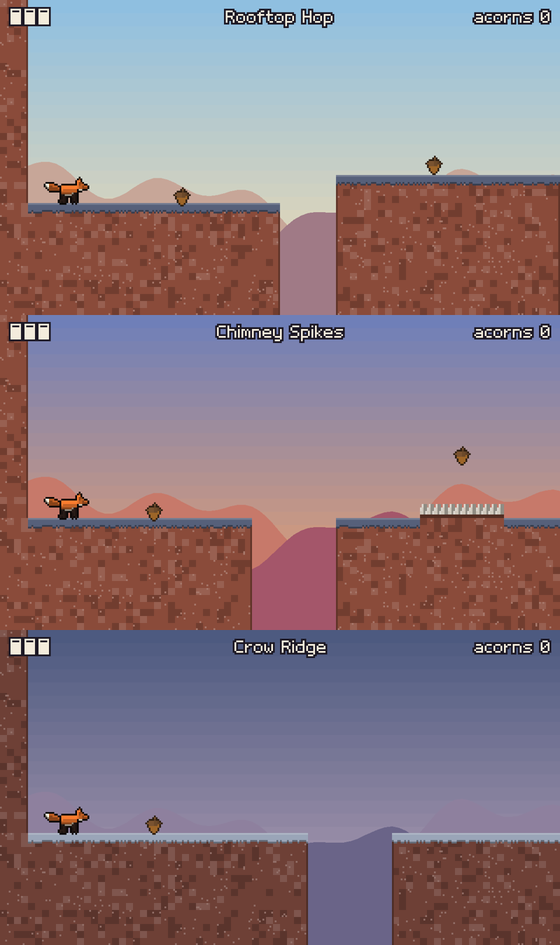
Built the first playable version: the brief, the game, the fox, the crow, and three levels, Rooftop Hop, Chimney Spikes and Crow Ridge.
The fox has gravity 50, a jump of 17 and runs at 8.5 tiles a second, with coyote time (a moment's grace to jump after leaving a ledge) and jump buffering (a jump pressed just early still counts).
It flagged what it couldn't know: nobody had played it yet, the first acorn came late, and the crows had been tested on only one route.
Proposed
Five proposals, each stacked on the one before.
The checks
Its playtest reached the win in 35.2 s.
Turn 3
Cost
not reported
Time
stopped at its 40-minute limit
The person
Played it, then said:
“nothing on screen tells me how I'm doing; mark it played; then autumn rooftops, a fox that reads as a fox, acorns, chimneys, crows”
The Director
Added a heads-up display (hearts, the level's name, acorns) and an autumn sky for each level that darkens toward winter.
The turn hit its 40-minute limit before the Director wrote its report, but both proposals were complete and green.
Proposed
Two: the heads-up display and the skies.
The checks
Both green.
Turn 4
Cost
$5.87
Time
not recorded
The person
“Give them real pixel-art sprites; keep the play exactly as it is”
The Director
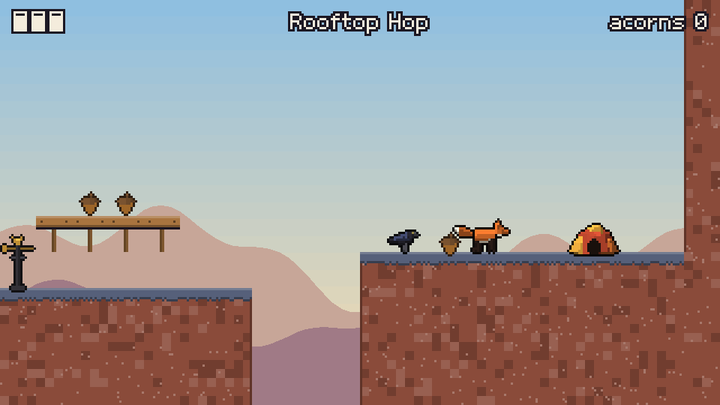
Drew pixel art for the fox, the acorns, the crows, the den and the weathervane, and looked at each one in a preview. The acorn took three tries: “the first version read as an onion.”
It asked the engine for two things instead of faking them: sprites that change the look without changing the game's state, and animals rigged so they can be animated.
Proposed
The pixel-art sprites.
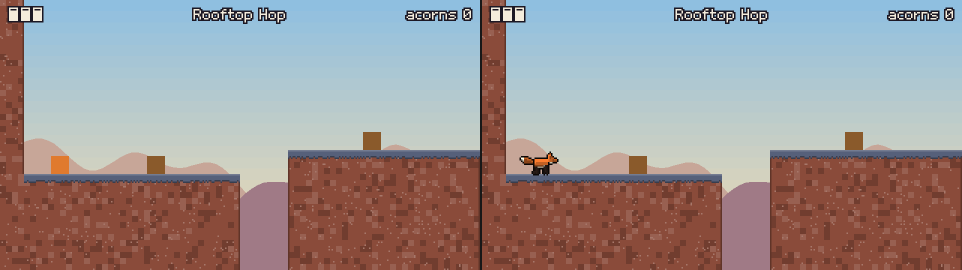
The fox before and after its sprite.The Director's staged preview: the fox, acorns on an awning, a crow, the den and the weathervane.The three levels as approved, autumn to dusk.
The result: Acorn Rooftops
Acorn Rooftops: run and jump across three rooftop levels, gather acorns, mind the chimney spikes and the crows, and reach the den. The sky darkens from an autumn afternoon toward winter as you go. The fox, acorns, crows, den and weathervane are the Director's own pixel art.
Since the run, its fox and crow have been rigged by hand to try the engine's new animation, so the fox now gallops and the crows strut. They are still the Director's drawings.
What it proved
A search of everywhere the fox can reach proves every level can be finished.
A playtest plays the saved routes to the win in 2,113 ticks with no deaths, twice, ending in the same state.
It needed no new kit: the platformer template and documents were enough.
Controls
Left or A
Run left
Right or D
Run right
Space or Z or K
Jump; hold it for a higher jump
Down or S
Climb down a ladder, or drop through a one-way platform
Up or W
Climb up a ladder
Esc or P
Pause and resume
Plays on a phone or tablet too, with on-screen controls.
Each finding as the run’s write-up recorded it, and what has happened since.
Sprites changed the game's state.
Fixed
Gamewright checks that a change to the look leaves play exactly as it was, by comparing fingerprints of the game's state. Sprites were part of that state, so a change to sprites alone couldn't pass.
Being fixed when the run was written up. Since then, parts that only draw, like sprites and poses, stay out of the game's state, so a sprite-only change passes.
Previews only showed the start of the game.
Fixed
To see level 3, the Director made a throwaway proposal that moved the fox's starting point.
Being fixed when the run was written up. Since then, a preview can go to any level, and to any place in it.
No way to animate an animal.
Answered
A running fox or a strutting crow needs rigged animals, which the engine didn't have.
Since then, a model can name joints and poses, and the platformer plays the clip for what a body is doing. The Director's own fox and crow were rigged, by hand and not by the Director, so they are still its drawings. The fox idles, gallops, jumps, falls and gets hurt; the crow struts. No fingerprint of the game's state moved.
“About a minute a level” was unproven.
Measured
The Director said so itself: “A minute per level … nobody has played it yet, so that's unproven.”
A bot now plays it as a person would, with reaction time, imprecise jumps and fumbles. Over 20 seeds, a casual player takes about 70 s for the three levels (Rooftop Hop 15 s, Chimney Spikes 22 s, Crow Ridge 34 s) and a novice about 110 s, giving up on Crow Ridge 4 times in 20. The hardest spot is the jump onto the first crow's roof: 22 of a casual player's 58 hurts on Crow Ridge. Every platformer now gets this playtest by default.